The name “Angono”(pronounce as either ‘A-ngo-no’ or ‘Ang-go-no) stems from various story sources. One such story describes the area of Angono as abundant in fish and animal life, with perennial grass and virgin forests, but infested with crocodiles.
The Spaniards who went there found a village of huts, consisting of 50 families and
ruled by a Datu Biga. The Datu’s dwelling was located on a hilltop, a place that still
presently bears his name “Biga”. Natives refer to their datu as “Ang Puno” or “Ang Uno,”
which was carried on with the Spaniards, also attributing it to the place where the Datu
and his followers resided.
Compared to other lakeshore settlements, Angono was seldom mentioned when the
Spaniards came to the Philippines, suggesting that it was populated less than those
which figured in historical documents.
Thus, it was to Cainta where Captain Juan de Salcedo started his pacification campaign
of the lake region in 1571. Natives from other settlements nearby reinforced the
defenders of Cainta, probably, some of them were from Angono. The natives were
called “Moros,” suggesting the early stages of Islamization just as Lakandula and
Sulayman were.
With the area pacified, Angono progressed as a “visita” starting in 1575. It was then one
of the twelve “visitas” in the vicinity of Pasig, which was the mother parish. Turning to
documents on descriptions of how lake-settlements looked like, a priest-historian,
Father Pedro Chirino, described the lake region in 1603 as one of the most remarkable
places in the world.
Other mother parish successively administered the “visita” of Angono. After Pasig, it
was a “visita” of Taguig, then Morong, and finally Binangonan. When Angono was a
“visita” of Binangonan sometime in 1737, both contained 100 “tributos” and taxpayers.
Both were always written together as “Pueblos de Bay y Binangonan con la estancia de
Angono.” Historical sources also refer to the Angono area, simultaneous with its growth
as a “visita”, as an “estancia” (ranch) and hacienda. Sources point out that a Spanish
general, Don Domingo de Otero Bermudez, purchased a hacienda in Angono in 1745.
Documents often pertain to Angono specifically as both “hacienda y estancia”.
The land tracts changed ownership several times. Later, owners at the end of the
Spanish regime subdivided them and sold to different owners, who secured their claims
under the Torrens little system. The livestock brought by the owners multiplied in great
number, opening up the world place of Angono for market and commercial
opportunities. Angono soon became a middle-of-the-way market where the townspeople
of Antipolo, Teresa, Taytay and Cainta met in direct trade and commerce. Balite was
the specific part of Angono that became a natural open market during Fridays.
In 1751, Angono became a “capellana” which was entitled to a cura paroco or chaplain.
After 15 years, Angono was created into a pueblo in 1766, although other sources place
the date in 1751 or 1753. Be that as it may, Angono had a population of 1,739 in 1766.
Juan Magbitac was its first gobernador-cillo. The Pueblo of Angono was then under the
jurisdiction of Laguna Province. Later, under the Distrito delas Montes de San Mateo,
which was renamed in 1857 to Politico Militar del Distrito de Morong. It remained part of
Morong’s political-military district until the end of the Spanish rule in 1898.
On June 11, 1901, the Philippine Commission enacted Act 137 creating Rizal Province
and incorporating Angono into it and a barrio of Binangonan. Another edict, Act 942
consolidated Angono and Cainta with Taytay, the seat of the new municipal
government. In November 1903, Act 948 separated Angono from Taytay and returned it
to Binangonan. It was in 1903 that Angono had a land tenure dispute that lasted up to
1909.
On August 19, 1938, through Executive Order 158 signed by Pres. Manuel L. Quezon,
Angono became an independent municipality effective January 1, 1939 with five (5)
barrios: Bagong Bayan, Poblacion, San Isidro, San Roque and San Vicente. By 1960
with another barrio added, Doña Aurora, the population reached 7,093. Republic Act
6469 of June 17, 1972 ratified Executive Order 158 and established legality of Angono’s
status as municipality. In 1975, the town was classified as a 5th class town with an
annual income of Php 520,000.00. It remains one of the 13 towns of Rizal out of the
original 26 towns, the other 13 having been included as part of greater Metro Manila or
developed as cities.
Angono today as a First Class municipality, is more well-known as a town with a unique
cultural life and history, with a unique and cultural life and history, with its citizens
having achieved much in the artistic fields of painting, music, sculpture and native
artistic traditions. The form is dotted with art shops and galleries and ateliers. A
household name is Carlos “Botong” Francisco, one of the Philippines’ most outstanding
post-war painters while Maestro Lucio D. San Pedro was a National Artist for Music.
ost-war painters while Maestro Lucio D. San Pedro was a National Artist for Music.
Fiestas and churches celebrations are special occasions when colorful traditions such
as the making of giant paper figures and displayed for both tourists and local residents.
Fiestas and churches celebrations are special occasions when colorful traditions such
as the making of giant paper figures and displayed for both tourists and local residents.
















































.jpg)
.jpg)
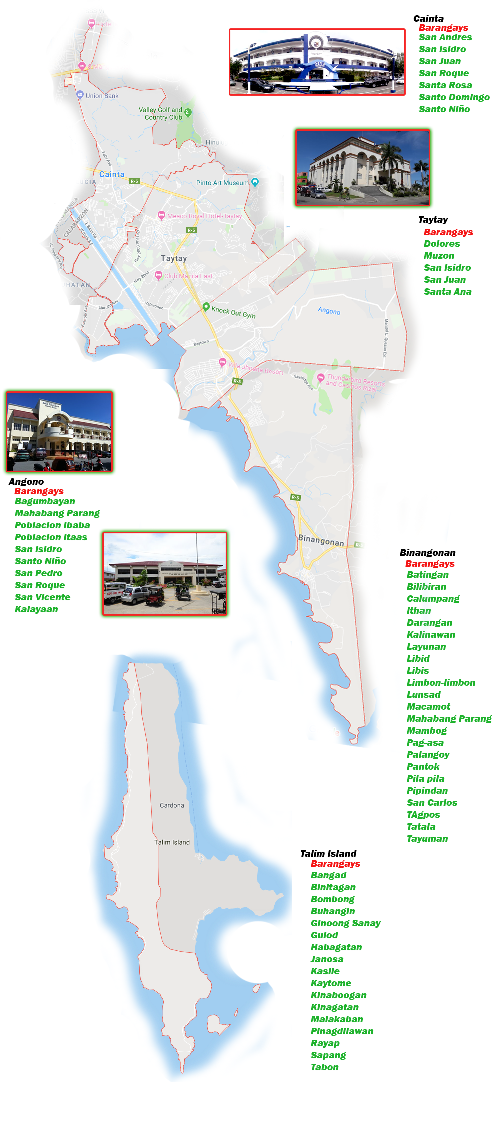
 Rizal Province
 Binangonan
 Cainta
 Taytay